MS Roald Amundsen - Chilean Fjords & Patagonia
The end-of-Antarctic-season repositioning from Ushuaia to Valparaiso, spent almost entirely inside the Chilean fjords: Garibaldi Fjord's tidewater glacier, the Strait of Magellan, and the White Narrows approach to Puerto Natales. Calls at roadless Puerto Eden and Caleta Tortel visit communities of a few hundred people reachable only by water.
Price Range
$$$$
Luxury
*Prices vary by cabin type, sailing date, and availability. Confirm rates with Hurtigruten before booking.
Ship Details — MS Roald Amundsen
View full MS Roald Amundsen details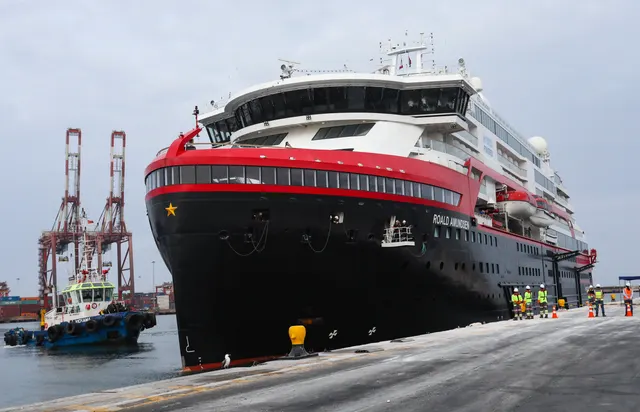
Year Built
2019
Tonnage
20,889 GT
Passengers
530
Crew
151
Decks
8
Class
Expedition
Itinerary & Route Map
Loading map…
Where this cruise calls, day by day
12 ports and 2 sea days over 13 Nights.
- Day 1
Ushuaia
ArgentinaDepartUshuaia sits on the Beagle Channel below the Martial range and bills itself as the world's southernmost city, which is mostly true and entirely commercial. It is the main embarkation port for Antarctic expedition ships, so the waterfront is a mix of outfitters, king crab restaurants and gangways. Passengers on round-South-America itineraries usually get a half day for the national park or a channel boat trip.
- Tierra del Fuego National Park and Lapataia Bay
- Beagle Channel catamaran trip to Les Eclaireurs lighthouse and the sea lion islets
- End of the World Train (Tren del Fin del Mundo)
- Museo del Presidio, the old prison that built the town
- Getting ashore
- Ships berth at the Muelle Comercial, a short walk from Avenida San Martin.
- Best months
- Nov-Mar
- Day 2
Garibaldi Fjord
ChilePortGaribaldi Fjord cuts north into Tierra del Fuego from the Beagle Channel, inside Alberto de Agostini National Park, and ends at the Garibaldi Glacier coming off the Darwin Icefield. Waterfalls drop out of hanging valleys on both walls, and unusually for Patagonia the Garibaldi has been advancing rather than retreating. Small ships either hold position at the face or land for a steep forest walk to a viewpoint.
- The Garibaldi Glacier face at the head of the fjord
- Waterfalls streaming off the fjord walls
- Steep hike through Magellanic forest to a glacier viewpoint
- Darwin Range peaks above the icefield
- Getting ashore
- Small expedition ships only; zodiac cruise or a landing for the viewpoint hike, weather permitting.
- Best months
- Oct-Mar
- Day 3
Ainsworth Bay
ChilePortAinsworth Bay is an inlet off Almirantazgo Sound in Chilean Tierra del Fuego, inside Alberto de Agostini National Park, and it is reached only by small expedition ship. The retreating Marinelli Glacier feeds it from the Darwin Icefield. Ashore, short walks lead through sub-polar Magellanic forest past beaver-flooded ground to a mossy waterfall; the beach here is one of the few southern elephant seal breeding sites in Chile, though the animals are not always present.
- Marinelli Glacier and the Darwin Range behind it
- Southern elephant seals on the beach (seasonal, not guaranteed)
- Magellanic sub-polar forest walk with beaver-dammed ponds
- Condors and kelp geese along the shoreline
- Getting ashore
- Zodiac landing from small expedition vessels only; large ships cannot enter.
- Best months
- Oct-Mar
- Day 4
Strait of Magellan (Scenic Cruising)
ChilePortThe strait is the sheltered route between the Atlantic and Pacific that Magellan found in 1520, and it is still the alternative to going round the Horn. Cruising it means a day of low brown steppe on the north shore and rising forested mountains on the Tierra del Fuego side, narrowing at Primera and Segunda Angostura where the tide runs hard. Commerson's dolphins and Peale's dolphins are common.
- Primera and Segunda Angostura, the two tidal narrows
- Commerson's and Peale's dolphins alongside
- The Tierra del Fuego shoreline and distant Darwin Range
- Punta Arenas and Fuerte Bulnes on the northern shore
- Getting ashore
- Scenic cruising; the strait is a transit route rather than a stop.
- Best months
- Nov-Mar
- Day 5
White Narrows (Scenic Cruising)
ChilePortThe White Narrows, or Angostura White, is the tightest point on the sea route into Puerto Natales — roughly 80 metres of navigable water with strong tidal streams running through it. Ships have to time the transit for slack water and daylight, so it often dictates the day's schedule rather than fitting into it. From the deck the rock walls come close enough that the passage is over faster than most people expect.
- The 80-metre-wide navigable gap, the narrowest on the Natales route
- Tidal currents and the slack-water timing the transit depends on
- Union Sound opening out beyond the narrows
- Steamer ducks and cormorants along the channel edges
- Getting ashore
- Scenic cruising — a short, tightly-timed transit with no landing.
- Best months
- Nov-Mar
- Day 6
Puerto Natales
ChilePortPuerto Natales sits on Ultima Esperanza Sound and functions almost entirely as the staging town for Torres del Paine, 110 km north. The waterfront has a good view across to the Balmaceda range, a scattering of gear shops and breweries, and a monument to the Milodon — a giant ground sloth whose remains were found in a cave nearby. A day here means either the park at speed or the cave and a boat trip.
- Torres del Paine National Park (a long but doable day trip)
- Cueva del Milodon, the giant ground sloth cave
- Boat trip up Ultima Esperanza to the Balmaceda and Serrano glaciers
- The waterfront and Cerro Dorotea lookout
- Getting ashore
- Ships berth or anchor off the town; the approach requires transiting the narrow White Narrows at slack tide.
- Best months
- Nov-Mar
- Day 7
Chilean Fjords (Exploration Day)
ChilePortAn exploration day in the fjords is deliberately unscheduled — the expedition team picks a spot that morning based on wind, ice and what the ship can safely enter. In practice that means zodiac cruising into an unnamed inlet, a shore walk on a cobble beach, or nosing towards a glacier face nobody had on the itinerary. It is the format small ships use where large ones can only sail past.
- Zodiac cruising into side fjords with no landing infrastructure
- Shore walks in Magellanic evergreen forest
- Tidewater glacier faces and waterfall-streaked walls
- Condors, black-browed albatross and Chilean dolphins
- Getting ashore
- Zodiac operations from small expedition ships; the specific site is decided on the day and may be dropped entirely.
- Best months
- Nov-Mar
- Day 8
Puerto Eden
ChilePortPuerto Eden is a settlement of a couple of hundred people on Wellington Island, with no roads in or out and no roads inside it either — everything is linked by wooden boardwalk along the shore. It is one of the last places where members of the Kawesqar people, who navigated these channels in canoes for thousands of years, still live. The setting is Bernardo O'Higgins National Park: rainforest, rain and fjord.
- The shoreline boardwalk that serves as the village's only street
- Kawesqar cultural heritage and locally made reed craft
- Bernardo O'Higgins National Park surroundings
- One of the wettest inhabited places in Chile, with the forest to match
- Getting ashore
- Ships anchor offshore and tender to the village pier; only small vessels call.
- Best months
- Nov-Mar
- Day 9
Caleta Tortel
ChilePortTortel is a village with no streets. Built in the 1950s for the cypress logging trade, it clings to a steep bay near the mouth of the Baker River and is connected entirely by kilometres of raised boardwalk and staircases made from local Guaitecas cypress. Getting around means climbing, which surprises people. It sits between the Northern and Southern Patagonian Ice Fields, and the weather generally reflects that.
- The cypress boardwalk network linking the whole village
- Cerro La Bandera lookout over the bay and the Baker River mouth
- The milky glacial colour of Tortel Bay
- Boat trips towards the Steffen and Jorge Montt glaciers
- Getting ashore
- Small expedition ships anchor and tender in; the village has no cruise berth and large ships cannot call.
- Best months
- Nov-Mar
Day 10 · At sea
- Day 11
Castro, Chiloe Island
ChilePortCastro is the main town of Chiloe, an island with its own mythology, its own architecture and a long history of doing things differently from the mainland. The signature sight is the palafitos — houses on stilts over the water at Gamboa and Pedro Montt, now half of them guesthouses. Chiloe's wooden churches, built by Jesuit missionaries without nails and shingled like upturned boats, are a UNESCO listing spread across the archipelago.
- Palafito stilt houses at Gamboa
- Iglesia San Francisco de Castro, yellow and purple, a UNESCO church
- Dalcahue and Achao churches on the wooden-church circuit
- Curanto, the local pit-cooked shellfish and meat dish
- Getting ashore
- Ships anchor in Castro fjord and tender in; the town has no cruise berth.
- Best months
- Dec-Mar (rain is likely in any month)
- Day 12
Niebla (Valdivia)
ChilePortNiebla is the coastal village at the mouth of the Valdivia river, and the call is really about two things: the Spanish colonial fort system and Valdivia city upriver. Castillo de Niebla, cut into the cliff, was one of a chain built to defend the estuary, with Corral and Mancera on the other side. Valdivia itself is 18 km inland, a German-founded university town with a riverside market where sea lions loiter for scraps.
- Castillo de la Pura y Limpia Concepcion de Monfort de Lemus at Niebla
- Corral and Mancera island forts across the bay
- Valdivia's Feria Fluvial market and its resident sea lions
- Kunstmann brewery and the town's German settlement heritage
- Getting ashore
- Ships anchor in Corral Bay and tender ashore; there is no cruise berth at Niebla.
- Best months
- Dec-Mar
Day 13 · At sea
- Day 14
Valparaiso
ChileArriveValparaiso is built on 40-odd hills above a working harbour, and the pleasure of it is getting lost — painted houses stacked on top of each other, murals on every retaining wall, and a set of Victorian funicular lifts still creaking up the slopes. Cerros Alegre and Concepcion hold most of the restaurants and the UNESCO-listed core. It doubles as the turnaround port for Santiago cruises, about 90 minutes inland.
- The ascensores (funiculars), including Reina Victoria and El Peral
- Cerro Alegre and Cerro Concepcion street art and cafes
- La Sebastiana, Pablo Neruda's hillside house
- Vina del Mar and the Casablanca Valley wineries nearby
- Getting ashore
- Ships berth at the Terminal de Pasajeros VTP in the port, with a short shuttle to Plaza Sotomayor.
- Best months
- Nov-Mar
Onboard Amenities
Cruise Highlights
About the Ship
What Travelers Say About MS Roald Amundsen
Reviews of the ship itself — the same for every MS Roald Amundsen sailing. Distilled from Cruise Critic member reviews and travel blogs; there is little traveler discussion of this ship.
MS Roald Amundsen is Hurtigruten's (now HX) headline ship as the world's first hybrid-electric expedition vessel, with battery banks that cut fuel and CO2 by roughly 20% and make for very quiet sailing. The vibe is active, nature-first and Norwegian-cool - it draws travelers who care about wildlife, science and sustainability rather than nightlife, wrapped in stylish Scandinavian hygge interiors with granite, pale woods and full-height panoramic windows. At 530 guests (capped at 500 for Antarctica) it's on the larger side for an expedition ship, which is the central trade-off in nearly every review.
What People Love
- World's first hybrid-electric expedition ship - battery banks cut fuel and CO2 by about 20% and make sailing notably quiet
- Excellent expedition and science team with daily landings, Zodiac cruises and lectures, plus a standout Amundsen Science Center
- Stylish Scandinavian hygge design with granite, birch and wool throws that feels more upscale than many expedition ships
Common Complaints
- Large for an expedition ship (530 guests, capped at 500 in Antarctica), so it feels less intimate than small vessels
- Rotating landings under the IAATO 100-person cap mean some days you don't get ashore until midday or later
- Recurring complaint that it's a budget product marketed as luxury, with food and service not fully matching the premium positioning
More South America Cruises
View all South America cruisesExplora Journeys
Explora I - Caribbean to the Amazon
Princess Cruises
Majestic Princess - Antarctica & South America from Buenos Aires
Silversea
Silver Nova - Rio de Janeiro to Buenos Aires
Carnival Cruise Line
Carnival Firenze - Chilean Fjords & Cape Horn: Santiago to Buenos Aires