MS Roald Amundsen - Iconic Antarctica: The Explorers' Route
HX's hybrid-powered MS Roald Amundsen sails roundtrip from Ushuaia (with included charter flights from Buenos Aires) on the Explorers' Route, spending nine days across the South Shetlands, Antarctic Sound, iceberg-filled Weddell Sea and the Gerlache and Penola Straits.
Price Range
$$$$$
Ultra-Luxury
*Prices vary by cabin type, sailing date, and availability. Confirm rates with Hurtigruten before booking.
Ship Details — MS Roald Amundsen
View full MS Roald Amundsen details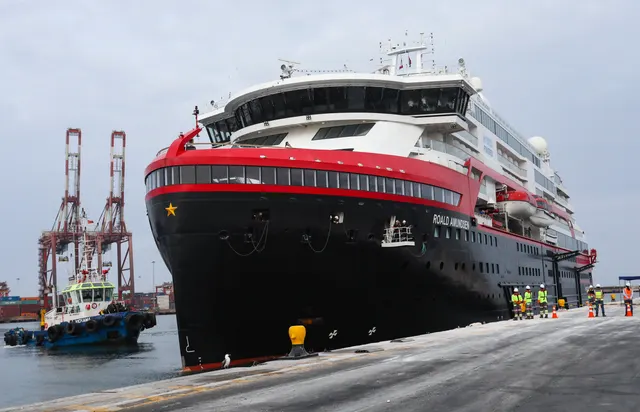
Year Built
2019
Tonnage
20,889 GT
Passengers
530
Crew
151
Decks
8
Class
Expedition
Itinerary & Route Map
Loading map…
Where this cruise calls, day by day
11 ports and 4 sea days over 14 Nights.
- Day 1
Ushuaia
ArgentinaDepartUshuaia sits on the Beagle Channel below the Martial range and bills itself as the world's southernmost city, which is mostly true and entirely commercial. It is the main embarkation port for Antarctic expedition ships, so the waterfront is a mix of outfitters, king crab restaurants and gangways. Passengers on round-South-America itineraries usually get a half day for the national park or a channel boat trip.
- Tierra del Fuego National Park and Lapataia Bay
- Beagle Channel catamaran trip to Les Eclaireurs lighthouse and the sea lion islets
- End of the World Train (Tren del Fin del Mundo)
- Museo del Presidio, the old prison that built the town
- Getting ashore
- Ships berth at the Muelle Comercial, a short walk from Avenida San Martin.
- Best months
- Nov-Mar
Day 2 · At sea
Day 3 · At sea
- Day 4
Half Moon Island (South Shetlands)
AntarcticaPortA crescent of rock and shingle about a mile across, tucked into the eastern side of Livingston Island, and for many ships it is the first Antarctic landing of the trip. The chinstrap colonies are spread over rocky outcrops behind the beach, and Argentina's Camara Base sits at one end, usually shuttered. Across the water the glaciated Burgas mountains of Livingston fill the horizon.
- Chinstrap penguin colonies on the rock outcrops
- Argentina's Camara Base
- Weddell seals hauled out on the shingle
- Views across to Livingston Island's icefields
- Getting ashore
- Zodiac landing on a shingle beach, weather permitting.
- Best months
- Nov-Mar (Antarctic season)
- Day 5
Antarctic Sound (Scenic Cruising)
AntarcticaPortListed as scenic cruising, this is a slow ship transit of the strait between the peninsula tip and Joinville Island, with no landing planned. The point is the ice: tabular bergs pushed out of the Weddell Sea, some flat-topped and a mile long, drifting north through the sound. Adelie penguins porpoise between the floes and the flanks of Brown Bluff and Hope Bay pass to port or starboard depending on direction.
- Weddell Sea tabular icebergs
- Brown Bluff's 745-metre volcanic cliff seen from the water
- Hope Bay and Esperanza Base from offshore
- Adelie penguins and Weddell seals on the floes
- Getting ashore
- Scenic cruising only; ice conditions frequently force the ship to turn back.
- Best months
- Jan-Mar
- Day 6
Brown Bluff
AntarcticaPortBrown Bluff is a tuya — a volcano that erupted under ice — and it looks it: a 745-metre wall of rust-brown rock rising straight off a boulder beach on the Antarctic Sound. It is one of the more reliable mainland landings, with thousands of Adelie pairs and a smaller number of gentoos nesting on the scree. Rockfall from the cliff is a real hazard and guides keep groups along the shoreline.
- Large Adelie penguin colony, with gentoos mixed in
- The rust-coloured tuya cliff face itself
- Continental landing on the Antarctic mainland
- Icebergs grounded on the beach shallows
- Getting ashore
- Zodiac landing on a cobble beach; swell off the Antarctic Sound often cancels it.
- Best months
- Dec-Feb
- Day 7
Devil Island (Weddell Sea)
AntarcticaPortDevil Island is a small ice-free island off the north coast of Vega Island, on the Weddell Sea side of the peninsula, with two rocky peaks and a bay between them. It holds an Adelie colony of several thousand pairs in a natural bowl, and the climb up one of the peaks gives you the whole thing from above along with a view over Erebus and Terror Gulf. Getting here at all requires the Antarctic Sound ice to cooperate.
- Adelie penguin colony in the island's central bowl
- The summit climb for a 360-degree view over Vega Island
- Tabular icebergs grounded in Erebus and Terror Gulf
- The volcanic geology of the James Ross Island group
- Getting ashore
- Zodiac landing; ice in the Weddell Sea approaches means many ships never reach it.
- Best months
- Jan-Mar
- Day 8
Gerlache Strait (Scenic Cruising)
AntarcticaPortThe Gerlache runs between the Palmer Archipelago and the peninsula mainland and functions as the main highway of Antarctic cruising — most ships transit it more than once. It is wide, deep and often surprisingly calm, with mountains on both sides and brash ice slapping the hull. It is also prime feeding water for humpbacks in late season, and ships will stop engines and drift when a pod is working krill nearby.
- Humpback and minke whales, best from late January
- Anvers Island and the Osterrieth Range to the west
- Brash ice and growlers in a flat-calm channel
- Access point for Wilhelmina Bay, Cuverville and the Errera Channel
- Getting ashore
- Scenic cruising; landings happen at sites off the strait rather than in it.
- Best months
- Jan-Mar for whales; Nov-Mar overall
- Day 9
Cuverville Island
AntarcticaPortCuverville sits in the Errera Channel and holds one of the largest gentoo colonies on the Antarctic Peninsula — several thousand pairs spread up the scree behind a cobble beach. The channel around it usually collects grounded icebergs, so the zodiac cruise is often as good as the landing. Expect noise, smell and pink guano-stained snow highways where the penguins commute to the water.
- Large gentoo penguin rookery on the island's lower slopes
- Grounded icebergs in the Errera Channel
- Kelp gulls, snowy sheathbills and skuas working the colony edges
- Leopard seals patrolling offshore
- Getting ashore
- Zodiac landing plus a zodiac cruise among the bergs; no facilities ashore.
- Best months
- Dec-Feb (chicks from late December)
- Day 10
Paradise Bay
AntarcticaPortWhalers named this bay, and for once the name holds up — it is a sheltered basin of glacier fronts and floating brash on the peninsula's west coast. Two research stations sit on its shores, Argentina's Almirante Brown and Chile's Gonzalez Videla at Waterboat Point, and one of them is usually the excuse for a landing. Most of the time here is spent in zodiacs, drifting under ice cliffs and watching for calving.
- Almirante Brown Station and the hill climb behind it
- Gonzalez Videla Station at Waterboat Point, with gentoos nesting between the buildings
- Skontorp Cove's ice cliffs and blue-eyed shag colony
- Zodiac cruising among grounded bergs
- Getting ashore
- Zodiac landing or zodiac cruise depending on ice and swell; there is no pier.
- Best months
- Nov-Mar (Antarctic season)
- Day 11
Lemaire Channel (Scenic Cruising)
AntarcticaPortA seven-mile slot between Booth Island and the Graham Land mainland, barely a mile wide at its narrowest, with cliffs going straight up on both sides. Photographers nicknamed it Kodak Gap for good reason: on a still day the water mirrors the walls and everyone is on deck. Ice frequently blocks the southern end, in which case the captain reverses out and nobody gets the picture.
- The twin spires of Cape Renard at the northern entrance
- Booth Island's ridgeline rising directly off the port rail
- Crabeater seals hauled out on drifting floes
- Reflections in the channel on a windless morning
- Getting ashore
- Scenic cruising only — no landing, and the transit is abandoned if pack ice fills the channel.
- Best months
- Dec-Feb (ice usually clears later in the season)
- Day 12
Deception Island
AntarcticaPortDeception is a flooded volcanic caldera in the South Shetlands, and ships sail into the crater through a gap in the wall called Neptune's Bellows that looks far too narrow from the bow. Inside is Port Foster, a black-sand harbour ringed by ash slopes. Whalers Bay holds the rusted boilers and tanks of an abandoned whaling station and the wrecked remains of a British base, all half-buried by a 1969 eruption.
- Neptune's Bellows, the caldera entrance
- Whalers Bay's rusting boilers, tanks and the ruins of Base B
- Baily Head's very large chinstrap penguin colony (landing rarely possible)
- Geothermally warmed shallows at Pendulum Cove
- Getting ashore
- The ship sails inside the caldera and passengers go ashore by zodiac; swell at the entrance sometimes cancels the call.
- Best months
- Nov-Mar (Antarctic season)
Day 13 · At sea
Day 14 · At sea
- Day 15
Ushuaia
ArgentinaArriveUshuaia sits on the Beagle Channel below the Martial range and bills itself as the world's southernmost city, which is mostly true and entirely commercial. It is the main embarkation port for Antarctic expedition ships, so the waterfront is a mix of outfitters, king crab restaurants and gangways. Passengers on round-South-America itineraries usually get a half day for the national park or a channel boat trip.
- Tierra del Fuego National Park and Lapataia Bay
- Beagle Channel catamaran trip to Les Eclaireurs lighthouse and the sea lion islets
- End of the World Train (Tren del Fin del Mundo)
- Museo del Presidio, the old prison that built the town
- Getting ashore
- Ships berth at the Muelle Comercial, a short walk from Avenida San Martin.
- Best months
- Nov-Mar
Onboard Amenities
Cruise Highlights
About the Ship
What Travelers Say About MS Roald Amundsen
Reviews of the ship itself — the same for every MS Roald Amundsen sailing. Based on 600 discussions.
MS Roald Amundsen is Hurtigruten's (now HX) headline ship as the world's first hybrid-electric expedition vessel, with battery banks that cut fuel and CO2 by roughly 20% and make for very quiet sailing. The vibe is active, nature-first and Norwegian-cool - it draws travelers who care about wildlife, science and sustainability rather than nightlife, wrapped in stylish Scandinavian hygge interiors with granite, pale woods and full-height panoramic windows. At 530 guests (capped at 500 for Antarctica) it's on the larger side for an expedition ship, which is the central trade-off in nearly every review.
What People Love
- World's first hybrid-electric expedition ship - battery banks cut fuel and CO2 by about 20% and make sailing notably quiet
- Excellent expedition and science team with daily landings, Zodiac cruises and lectures, plus a standout Amundsen Science Center
- Stylish Scandinavian hygge design with granite, birch and wool throws that feels more upscale than many expedition ships
Common Complaints
- Large for an expedition ship (530 guests, capped at 500 in Antarctica), so it feels less intimate than small vessels
- Rotating landings under the IAATO 100-person cap mean some days you don't get ashore until midday or later
- Recurring complaint that it's a budget product marketed as luxury, with food and service not fully matching the premium positioning