MS Roald Amundsen - Antarctica: The Explorers' Route
HX's hybrid-powered MS Roald Amundsen sails roundtrip from Ushuaia (with included charter flights from Buenos Aires) on the Explorers' Route, spending nine days across the South Shetlands, Antarctic Sound, iceberg-filled Weddell Sea and the Gerlache and Penola Straits.
Price Range
$$$$$
Ultra-Luxury
*Prices vary by cabin type, sailing date, and availability. Confirm rates with Hurtigruten before booking.
Ship Details — MS Roald Amundsen
View full MS Roald Amundsen details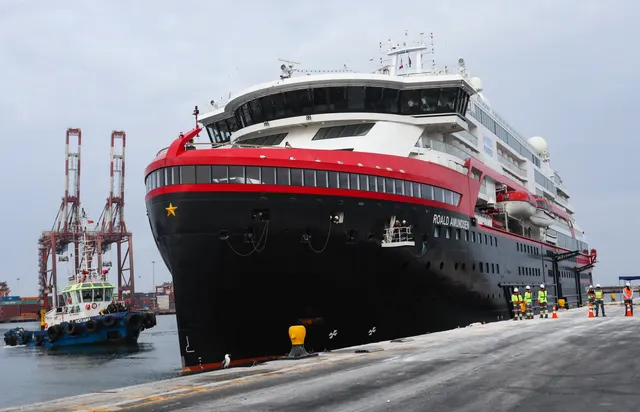
Year Built
2019
Tonnage
20,889 GT
Passengers
530
Crew
151
Decks
8
Class
Expedition
Itinerary & Route Map
Loading map…
Where this cruise calls, day by day
6 ports of call and 4 sea days over 14 Nights.
- Day 1
Ushuaia
ArgentinaDepartUshuaia sits on the Beagle Channel below the Martial range and bills itself as the world's southernmost city, which is mostly true and entirely commercial. It is the main embarkation port for Antarctic expedition ships, so the waterfront is a mix of outfitters, king crab restaurants and gangways. Passengers on round-South-America itineraries usually get a half day for the national park or a channel boat trip.
- Tierra del Fuego National Park and Lapataia Bay
- Beagle Channel catamaran trip to Les Eclaireurs lighthouse and the sea lion islets
- End of the World Train (Tren del Fin del Mundo)
- Museo del Presidio, the old prison that built the town
- Getting ashore
- Ships berth at the Muelle Comercial, a short walk from Avenida San Martin.
- Best months
- Nov-Mar
Day 2 · At sea
Day 3 · At sea
- Day 4
South Shetland Islands
AntarcticaPortThe South Shetlands are a chain of 11 major islands off the tip of the Antarctic Peninsula, 80 to 90% under permanent ice, and usually the first part of Antarctica a ship from Ushuaia reaches after the Drake Passage. King George Island holds most of the group's 16 research stations, several of them open year-round. Landings are by Zodiac and only from expedition ships of 500 or fewer guests, since IAATO members do not land passengers from larger ships; the expedition team picks sites on the day for weather and ice.
- Penguins, seals and seabirds at landing sites such as Half Moon Island and the Aitcho Islands
- Deception Island, among the most visited stops in the group
- Hannah Point on the south coast of uninhabited Livingston Island
- Research stations on King George Island, the largest island
- Getting ashore
- No piers: the ship stays offshore and lands guests by Zodiac. IAATO allows landings only from ships carrying 500 or fewer passengers.
- Best months
- Dec-Mar (the surrounding waters are frozen from about April to early December)
- Day 5
Antarctic Sound (Scenic Cruising)
AntarcticaPortListed as scenic cruising, this is a slow ship transit of the strait between the peninsula tip and Joinville Island, with no landing planned. The point is the ice: tabular bergs pushed out of the Weddell Sea, some flat-topped and a mile long, drifting north through the sound. Adelie penguins porpoise between the floes and the flanks of Brown Bluff and Hope Bay pass to port or starboard depending on direction.
- Weddell Sea tabular icebergs
- Brown Bluff's 745-metre volcanic cliff seen from the water
- Hope Bay and Esperanza Base from offshore
- Adelie penguins and Weddell seals on the floes
- Getting ashore
- Scenic cruising only; ice conditions frequently force the ship to turn back.
- Best months
- Jan-Mar
- Day 6
Weddell Sea
AntarcticaPortThe Weddell Sea lies east of the Antarctic Peninsula and is often clogged with heavy pack ice, which is why only ice-strengthened ships go in. It is where Shackleton's Endurance was trapped and crushed in 1915; the wreck was found in 2022 at a depth of 3,008 m. The Antarctic Sound, the gateway in from the peninsula, is known for its huge tabular icebergs and Adelie penguins. As everywhere in Antarctica, landings are only for expedition ships of 500 or fewer guests under IAATO rules, and the day's plan depends on the ice.
- Tabular icebergs in the Antarctic Sound, the gateway from the peninsula
- Adelie penguins in the Antarctic Sound
- The waters where Shackleton's Endurance was lost
- A chance of emperor penguins from the colony near Snow Hill Island, the northernmost known
- Getting ashore
- No piers: landings and ice cruising are by Zodiac from the ship, only on vessels of 500 or fewer passengers (IAATO), and heavy pack ice can close sites.
- Best months
- Dec-Mar
- Day 7
Gerlache Strait (Scenic Cruising)
AntarcticaPortThe Gerlache runs between the Palmer Archipelago and the peninsula mainland and functions as the main highway of Antarctic cruising — most ships transit it more than once. It is wide, deep and often surprisingly calm, with mountains on both sides and brash ice slapping the hull. It is also prime feeding water for humpbacks in late season, and ships will stop engines and drift when a pod is working krill nearby.
- Humpback and minke whales, best from late January
- Anvers Island and the Osterrieth Range to the west
- Brash ice and growlers in a flat-calm channel
- Access point for Wilhelmina Bay, Cuverville and the Errera Channel
- Getting ashore
- Scenic cruising; landings happen at sites off the strait rather than in it.
- Best months
- Jan-Mar for whales; Nov-Mar overall
- Day 8
Lemaire Channel (Scenic Cruising)
AntarcticaPortA seven-mile slot between Booth Island and the Graham Land mainland, barely a mile wide at its narrowest, with cliffs going straight up on both sides. Photographers nicknamed it Kodak Gap for good reason: on a still day the water mirrors the walls and everyone is on deck. Ice frequently blocks the southern end, in which case the captain reverses out and nobody gets the picture.
- The twin spires of Cape Renard at the northern entrance
- Booth Island's ridgeline rising directly off the port rail
- Crabeater seals hauled out on drifting floes
- Reflections in the channel on a windless morning
- Getting ashore
- Scenic cruising only — no landing, and the transit is abandoned if pack ice fills the channel.
- Best months
- Dec-Feb (ice usually clears later in the season)
- Day 9
Antarctic Peninsula
AntarcticaPortThe peninsula is the arm of Antarctica reaching north towards South America, and it is where almost every Antarctic cruise actually spends its time. Itineraries list it as a single port but it means several days of ship-cruising between bays, channels and islands, with two zodiac outings a day when weather allows. Nothing is fixed — the daily plan is announced the night before and rewritten by morning if the wind turns.
- Gentoo, chinstrap and Adelie colonies at different sites along the coast
- Humpback and minke whales feeding on krill in the bays
- Leopard and crabeater seals on ice floes
- Working and historic research stations, including Port Lockroy
- Getting ashore
- Everything is by zodiac — landings and cruises both, and both are weather-dependent.
- Best months
- Nov-Mar (Antarctic season)
- Day 10
Antarctic Peninsula
AntarcticaPortThe peninsula is the arm of Antarctica reaching north towards South America, and it is where almost every Antarctic cruise actually spends its time. Itineraries list it as a single port but it means several days of ship-cruising between bays, channels and islands, with two zodiac outings a day when weather allows. Nothing is fixed — the daily plan is announced the night before and rewritten by morning if the wind turns.
- Gentoo, chinstrap and Adelie colonies at different sites along the coast
- Humpback and minke whales feeding on krill in the bays
- Leopard and crabeater seals on ice floes
- Working and historic research stations, including Port Lockroy
- Getting ashore
- Everything is by zodiac — landings and cruises both, and both are weather-dependent.
- Best months
- Nov-Mar (Antarctic season)
- Day 11
Antarctic Peninsula
AntarcticaPortThe peninsula is the arm of Antarctica reaching north towards South America, and it is where almost every Antarctic cruise actually spends its time. Itineraries list it as a single port but it means several days of ship-cruising between bays, channels and islands, with two zodiac outings a day when weather allows. Nothing is fixed — the daily plan is announced the night before and rewritten by morning if the wind turns.
- Gentoo, chinstrap and Adelie colonies at different sites along the coast
- Humpback and minke whales feeding on krill in the bays
- Leopard and crabeater seals on ice floes
- Working and historic research stations, including Port Lockroy
- Getting ashore
- Everything is by zodiac — landings and cruises both, and both are weather-dependent.
- Best months
- Nov-Mar (Antarctic season)
- Day 12
Antarctic Peninsula
AntarcticaPortThe peninsula is the arm of Antarctica reaching north towards South America, and it is where almost every Antarctic cruise actually spends its time. Itineraries list it as a single port but it means several days of ship-cruising between bays, channels and islands, with two zodiac outings a day when weather allows. Nothing is fixed — the daily plan is announced the night before and rewritten by morning if the wind turns.
- Gentoo, chinstrap and Adelie colonies at different sites along the coast
- Humpback and minke whales feeding on krill in the bays
- Leopard and crabeater seals on ice floes
- Working and historic research stations, including Port Lockroy
- Getting ashore
- Everything is by zodiac — landings and cruises both, and both are weather-dependent.
- Best months
- Nov-Mar (Antarctic season)
Day 13 · At sea
Day 14 · At sea
- Day 15
Ushuaia
ArgentinaArriveUshuaia sits on the Beagle Channel below the Martial range and bills itself as the world's southernmost city, which is mostly true and entirely commercial. It is the main embarkation port for Antarctic expedition ships, so the waterfront is a mix of outfitters, king crab restaurants and gangways. Passengers on round-South-America itineraries usually get a half day for the national park or a channel boat trip.
- Tierra del Fuego National Park and Lapataia Bay
- Beagle Channel catamaran trip to Les Eclaireurs lighthouse and the sea lion islets
- End of the World Train (Tren del Fin del Mundo)
- Museo del Presidio, the old prison that built the town
- Getting ashore
- Ships berth at the Muelle Comercial, a short walk from Avenida San Martin.
- Best months
- Nov-Mar
What to know about this sailing
Nobody has posted about MS Roald Amundsen's Antarctic sailings, so this note works mainly from HX's own itinerary page and the port notes, with one traveler account of a peninsula trip from Ushuaia on another ship.
Two sea days out and two back are the Drake Passage, and they bracket nine days on the far side arranged as a loop that runs east before it runs west. HX plans the South Shetland Islands first, then rounds the tip of the peninsula into the Antarctic Sound and the Weddell Sea, the tabular-iceberg and Adelie-penguin side of the peninsula, before doubling back through the Gerlache Strait and the Lemaire Channel or Penola Strait to the west coast. HX names regions rather than landing sites, and the four open Antarctic Peninsula days are left to the expedition team, decided on the day by weather and ice. The Antarctic Sound and Weddell Sea are the concrete difference between this route and the standard west-coast circuit. The Buenos Aires to Ushuaia charter is bundled into the fare, so in practice the trip begins and ends in Buenos Aires.
Against the alternatives: the ship's own Antarctic Circle Expedition, at $13,806, gives up the Antarctic Sound and Weddell Sea to push south toward the Circle and Marguerite Bay for about $2,600 more per person. Seabourn Venture's 10-night Great White Continent shares the Sound, Gerlache, Lemaire and Paradise Bay for $11,729, slightly more than this sailing for four fewer nights, so it is the shorter but not the cheaper way to see the west-coast highlights, and Silver Endeavour's 6-night fly-cruise, which avoids the Drake by flying across it, costs $19,900. The buyer here wants the Weddell Sea's ice and Adelie rookeries alongside the standard west-coast circuit and will spend four days in the Drake to get it; it is the wrong choice for anyone whose priority is South Georgia, which this route never approaches, or who wants to skip the Drake, where the Silversea fly-cruise is the only option on this site.
Nothing has been posted from this ship in Antarctica. The one relevant thread is a widely read December 2023 account from a couple already travelling in Argentina who walked into an agency in Ushuaia and booked a 10-night peninsula cruise on another line two weeks before departure for less than half the advertised fare, choosing from more than a dozen ships and dates. The replies are mostly about affordability, and the poster's own caveat is that it requires being in Ushuaia with weeks of flexibility, a model that does not map onto a package with charter flights bundled in. The same thread puts the Drake at two days each way, which matches the sea days on this itinerary.
Questions about this sailing
Can you get a last-minute deal on an Antarctica cruise from Ushuaia?
The one traveler thread on this route says yes, with conditions. A couple already travelling in Argentina booked a 10-night peninsula cruise on another line through a local agency about two weeks before departure for less than half the advertised fare, and reported people on board who had booked the night before at the same price. It only works with weeks of flexibility in Ushuaia, and HX's package, with charter flights from Buenos Aires included, is not sold that way.
How long is the Drake Passage crossing on this itinerary?
Two sea days in each direction, at the start and the end of the voyage. That matches the one traveler account from this route, written on a different ship; no one has described this ship's own crossings.
Onboard Amenities
Cruise Highlights
About the Ship
What Travelers Say About MS Roald Amundsen
Reviews of the ship itself — the same for every MS Roald Amundsen sailing. Distilled from passenger reviews and travel blogs; there is little traveler discussion of this ship.
MS Roald Amundsen is Hurtigruten's (now HX) headline ship as the world's first hybrid-electric expedition vessel, with battery banks that cut fuel and CO2 by roughly 20% and make for very quiet sailing. The vibe is active, nature-first and Norwegian-cool - it draws travelers who care about wildlife, science and sustainability rather than nightlife, wrapped in stylish Scandinavian hygge interiors with granite, pale woods and full-height panoramic windows. At 530 guests (capped at 500 for Antarctica) it's on the larger side for an expedition ship, which is the central trade-off in nearly every review.
What People Love
- World's first hybrid-electric expedition ship - battery banks cut fuel and CO2 by about 20% and make sailing notably quiet
- Excellent expedition and science team with daily landings, Zodiac cruises and lectures, plus a standout Amundsen Science Center
- Stylish Scandinavian hygge design with granite, birch and wool throws that feels more upscale than many expedition ships
Common Complaints
- Large for an expedition ship (530 guests, capped at 500 in Antarctica), so it feels less intimate than small vessels
- Rotating landings under the IAATO 100-person cap mean some days you don't get ashore until midday or later
- Recurring complaint that it's a budget product marketed as luxury, with food and service not fully matching the premium positioning