AmaMagna - Gems of Southeast Europe
The Lower Danube run from Giurgiu to Budapest through Bulgaria, Serbia, and Croatia - a completely different river than the castle-lined upper stretch. The route's centerpiece is a day of scenic cruising through the Iron Gates gorge past Golubac Fortress, bookended by Veliko Tarnovo excursions from Rousse and Belgrade's fortress and bohemian quarter.
Price Range
$$$$
Luxury
*Prices vary by cabin type, sailing date, and availability. Confirm rates with AmaWaterways before booking.
Ship Details — AmaMagna
View full AmaMagna details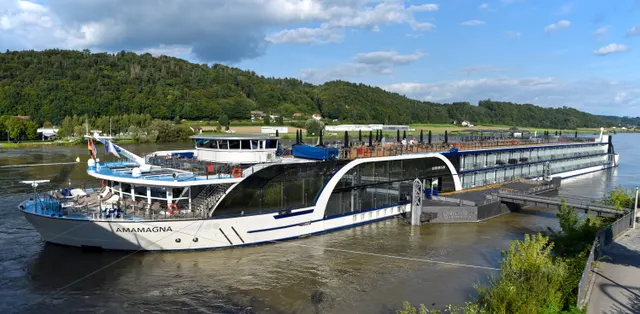
Year Built
2019
Tonnage
N/A
Passengers
196
Crew
70
Decks
4
Class
River
Itinerary & Route Map
Loading map…
Where this cruise calls, day by day
8 ports over 7 Nights.
- Day 1
Giurgiu
RomaniaDepartGiurgiu is a transfer point and the day is best planned that way. It is a Romanian freight port of 55,000 facing Ruse across the water, joined to Bulgaria by the Friendship Bridge of 1954, and the town holds little for a visitor - its fortifications were razed by 1829. Nearly everyone who ties up here is on a coach to Bucharest within the hour.
- Bucharest, 64km north - the Palace of the Parliament and the Lipscani old town
- The Clock Tower, built in 1771 as an Ottoman watchtower over Danube traffic
- The Friendship Bridge across the Danube to Ruse, on the edge of town
- Getting ashore
- Docked at the working river port; the coach to Bucharest takes about an hour and a half each way, and there is little reason to linger in town.
- Best months
- May-Jun and Sep-Oct
- Day 2
Rousse
BulgariaPortRuse is Bulgaria's main Danube port, and its centre looks unlike the rest of the country - neo-baroque and secession facades put up when 19th-century merchant and customs money arrived, which is why it gets called the little Vienna of the Danube. Ships tie up within walking distance of Freedom Square. The excursions inland are the stronger half of the day.
- The Ivanovo Rock-Hewn Churches, 14th-century frescoes cut into a cliff 32m above the river
- Basarbovo, the only working cave monastery left in Bulgaria, 9km out of town
- Veliko Tarnovo and the Tsarevets fortress, capital of the Second Bulgarian Empire
- The Monument of Liberty on Freedom Square and the neo-baroque streets around it
- Getting ashore
- Docked on the Ruse riverfront, a short walk from the centre; Ivanovo is about 26km out, and Veliko Tarnovo is 108km and roughly two hours each way by coach.
- Best months
- May-Jun and Sep-Oct
- Day 3
Vidin
BulgariaPortVidin has gone from about 65,000 people to under 35,000 since 1989, and it does not hide it - shuttered shopfronts and wide quiet streets. The compensation is Baba Vida, a largely intact medieval fortress standing on the bank at the end of the pedestrian street, a short walk from where the ship ties up. The main excursion runs inland to the Belogradchik rocks.
- Baba Vida fortress on the riverbank, built between the 10th and 14th centuries
- The Belogradchik Rocks - sandstone towers up to 200m high over some 50 square km
- Belogradchik Fortress, whose walls use the rock formations themselves as defences
- The New Europe Bridge to Calafat, only the second bridge ever built between the two banks
- Getting ashore
- Docked on the Vidin quay at the foot of the pedestrian centre; Baba Vida is a short riverside walk, and Belogradchik is 58km and about 1hr15 each way by coach.
- Best months
- May-Jun and Sep-Oct
- Day 4
Iron Gates (Scenic Cruising)
SerbiaPortThe Iron Gates transit ends at the Djerdap dam, and locking through it is a slow, oddly compelling piece of engineering theatre. The dam raised the river about 20m when it closed, drowning villages and the Ottoman island of Ada Kaleh, whose 600-odd residents had already left for Turkey. A good deal of what this gorge used to look like is underneath the water you are floating on.
- Locking through the Iron Gate I dam, a 60m-high, 1,278m-long wall finished in 1972
- Golubac Fortress at the upstream end, where the gorge narrows to 230m
- Lepenski Vir, the Mesolithic settlement moved uphill as the reservoir rose
- The Kazan narrows and the Decebalus rock carving on the Romanian shore
- Getting ashore
- No berth - a scenic transit and a lock passage. Timings shift with barge traffic at the dam, so which parts fall in daylight is not guaranteed.
- Best months
- May-Jun and Sep-Oct
- Day 5
Belgrade
SerbiaPortBelgrade has been fought over and rebuilt so often that it has no single old quarter - Habsburg blocks, Ottoman traces, socialist concrete and new riverfront towers sit within a few streets of each other. River ships moor close to the centre, frequently rafted two or three deep. Kalemegdan Fortress, on the bluff above the confluence of the Sava and the Danube, is the obvious first stop and it is walkable.
- Kalemegdan Fortress and the Victor monument above the Sava-Danube confluence
- Knez Mihailova, the pedestrian spine, and the old taverns of Skadarlija
- The Church of Saint Sava, among the largest Orthodox churches in the world
- The House of Flowers, Tito's mausoleum, up at Dedinje
- Getting ashore
- Moored at the passenger quay on the Sava rather than the Danube cargo port, a short walk below Kalemegdan; as everywhere on the rivers, ships may raft alongside each other and you cross another vessel to get ashore.
- Best months
- May-Jun and Sep-Oct (Jul-Aug is hot, and low water on the Danube can force coach transfers)
- Day 6
Vukovar
CroatiaPortVukovar was besieged for 87 days in 1991 and largely destroyed, and its memory of that is the substance of a visit rather than a footnote to it. The shell-scarred water tower has been left as the fighting finished it and opened as a memorial. Parts of the baroque town have been rebuilt, and the guides here are frequently people who lived through the siege.
- The Vukovar Water Tower, hit more than 600 times and never repaired, open since 2020
- The Ovcara Memorial Centre, 8km out, and the hospital's Place of Memory in the basement
- The Vucedol Culture Museum and its Copper Age settlement downstream of the town
- Ilok, the wine town 35km upriver, with its Odescalchi castle and cellars
- Getting ashore
- Docked on the Danube quay in the centre of Vukovar; the town is walkable, the water tower a short shuttle or a 20-minute walk, and Ovcara about 8km out by coach.
- Best months
- May-Jun and Sep-Oct
- Day 7
Mohacs
HungaryPortMohács is as much a border formality as a destination - it is where Danube itineraries clear in and out of Hungary. Its name belongs to the 1526 battle that broke medieval Hungary and opened the country to Ottoman rule; a memorial park stands on the field with carved wooden markers over the mass graves. Most calls coach onward to Pécs.
- The Mohács battlefield memorial park and its carved grave markers
- Pécs, about an hour away, with its early Christian necropolis and Zsolnay ceramics
- The Busó masks of the Busójárás carnival, on display in town year-round
- Villány wine country, the Hungarian red-wine region south of Pécs
- Getting ashore
- Vessels moor at the town quay on the Danube; the town is a short walk but thin on sights, and excursions leave by coach.
- Best months
- Apr-Oct; Feb for the Busójárás carnival, though that is outside most cruise seasons
- Day 8Budapest port guide: where ships dock and what to do ashore
Budapest
HungaryArrive
Onboard Amenities
Cruise Highlights
About the Ship
What Travelers Say About AmaMagna
Reviews of the ship itself — the same for every AmaMagna sailing. Distilled from 1 traveler threads, Cruise Critic member reviews and travel blogs.
AmaMagna is the unicorn of the Danube: a river ship built to roughly twice the standard 38-foot width, which lets AmaWaterways pour all that extra real estate into suite-style cabins (252-710 sq ft) and amenities you simply don't find on conventional river vessels. With only about 196 guests aboard a hull this large, the defining feeling is space and low density - wide corridors, big balconies, and an uncrowded sun deck. The vibe is upscale-active rather than stuffy, blending fine dining with a wellness-and-adventure streak that sets it apart from the more sedate norm of European river cruising.
What People Love
- An extra-wide 72-ft double hull (vs ~38 ft on standard river ships) yields noticeably larger, suite-style cabins of 252-710 sq ft, most with French or step-out balconies
- Four distinct dining venues - rare for a river ship - including the complimentary Chef's Table tasting menu and Jimmy's Wine Bar & Restaurant
- Food is repeatedly described as 5-star and the most consistent point of praise across every review source
Common Complaints
- Commands a premium price over standard AmaWaterways ships (~$8,000 per person for 7 nights cited), and some reviewers felt the value didn't fully match the cost
- Its width limits it to wider waterways, making it effectively a Danube-only ship and ruling out the Rhine, Main, Moselle, and Douro
- Danube water-level and weather disruptions cause itinerary changes - one April-May 2026 sailing was halted in Vienna due to low water, fueling several negative reviews