Seabourn Pursuit - Kimberley Expedition: Waterfalls & Wandjinas
A ten-night expedition along Australia's remote Kimberley coast from Darwin to Broome, where the ship's 24 Zodiacs do the real work: running the gorge below King George Falls, riding the tidal rush at Talbot Bay's Horizontal Falls, and watching Montgomery Reef appear out of the sea on the falling tide. Shore visits include Wandjina and Gwion Gwion rock art with Worrorra traditional owners.
Price Range
$$$$$
Ultra-Luxury
*Prices vary by cabin type, sailing date, and availability. Confirm rates with Seabourn before booking.
Ship Details — Seabourn Pursuit
View full Seabourn Pursuit details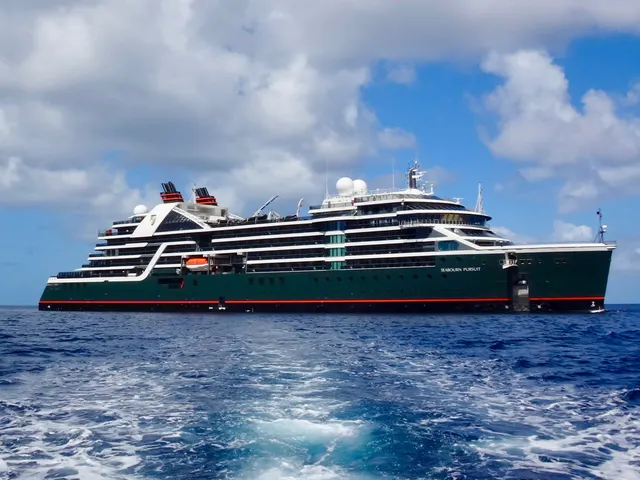
Year Built
2023
Tonnage
23,000 GT
Passengers
264
Crew
230
Decks
8
Class
Polar Class 6 Expedition
Itinerary & Route Map
Loading map…
Where this cruise calls, day by day
10 ports and 1 sea day over 10 Nights.
- Day 1
Darwin
AustraliaDepartDarwin is the closest Australian capital to Asia and feels it - a small, hot, rebuilt city that has been flattened twice, by Japanese bombing in 1942 and by Cyclone Tracy in 1974. Both stories are told well here. Ships use Fort Hill Wharf just below the CBD, and the walk up the escarpment into town is short but steep in the heat.
- Museum and Art Gallery of the Northern Territory - the Cyclone Tracy room and Sweetheart the crocodile
- Mindil Beach Sunset Market, dry-season Thursdays and Sundays
- WWII oil storage tunnels under the waterfront
- Litchfield National Park waterfalls, about 90 minutes out
- Getting ashore
- Docked at Fort Hill Wharf, though some calls get the commercial port instead; the CBD sits on the cliff above and there is a public lift up the escarpment, which makes it about 15 minutes on foot - the Waterfront Precinct is immediately alongside.
- Best months
- May-Sep (dry season)
Day 2 · At sea
- Day 3
King George River, WA
AustraliaPortThe ship anchors in Koolama Bay on the Timor Sea and Zodiacs run roughly twelve kilometres up a gorge of sheer red sandstone to the twin King George Falls. Whether they are a roaring double curtain or two dark stains on the rock depends entirely on how long ago the wet season ended - the flow tails off badly by late in the season. When it is running, the drivers nose the Zodiac in under the water.
- Zodiac run up the gorge to the base of the twin King George Falls
- Taking the Zodiac under the cascade for a freshwater shower, flow permitting
- The layered sandstone gorge walls, which close in on both sides
- Ospreys, rock wallabies and crocodiles along the transit
- Getting ashore
- No landing - the ship anchors in Koolama Bay at the river mouth and the whole visit is a Zodiac run up the gorge and back.
- Best months
- Apr-May for the strongest falls; Jun-Aug for calmer seas and less water
- Day 4
Vansittart Bay, WA
AustraliaPortVansittart Bay holds two very different Kimberley attractions within a short Zodiac ride of each other. On the salt flats of the Anjo Peninsula lies the wreck of a WWII C-53 transport that crash-landed in 1942, still largely intact and lying in the open. Nearby, Jar Island has sandstone shelters containing Gwion Gwion rock art, among the oldest figurative painting anywhere.
- The C-53 Skytrooper wreck, force-landed on the salt pan in February 1942 with everyone aboard rescued
- Gwion Gwion rock art shelters on Jar Island (Ngula), named for the earthenware jars left by Makassan trepang fishers
- Zodiac cruising among the bay's islands and mangrove edges
- Enormous tidal flats and the birdlife they attract
- Getting ashore
- No wharf - the ship anchors and Zodiacs make beach landings, one for the aircraft wreck and one for the rock art.
- Best months
- Apr-Sep (Kimberley dry season)
- Day 5
Ashmore Reef
AustraliaPortAshmore Reef is an Australian marine reserve in the Timor Sea, far closer to Indonesia than to the Australian mainland - a submerged platform with a few low sand cays on it. Only expedition ships repositioning between the Kimberley and Indonesia come here. Access is tightly controlled and landings are restricted, so the visit is normally Zodiac cruising and snorkelling rather than time ashore.
- Zodiac cruising over the reef flats and lagoon
- Snorkelling among the sea snakes, for which the reef is unusually well known
- Seabird colonies and green turtles around the sand cays
- Getting ashore
- No wharf and no settlement; access is by Zodiac from the ship under a permit, and landings on the cays are restricted.
- Best months
- Apr-Sep (dry season, when Kimberley expedition ships operate)
- Day 6
Hunter River, WA
AustraliaPortThe Hunter River is an anchorage rather than a place - the ship parks off Naturalist Island on the north Kimberley coast and everyone gets into Zodiacs. The run up Porosus Creek, named after the saltwater crocodile, takes you deep into mangroves where the crocs sit out on the banks, and the guides explain at some length why nobody trails a hand in the water. Naturalist Island is also where the helicopters land.
- Zodiac cruise up Porosus Creek through the mangroves for saltwater crocodiles
- Helicopter flight from Naturalist Island to Mitchell Falls (Punamii-Uunpuu)
- Mangrove birdlife - kingfishers, egrets and white-bellied sea eagles
- Red sandstone escarpment behind the river, and mudflats exposed by the huge tides
- Getting ashore
- No dock - the ship anchors offshore and everything runs by Zodiac, timed to the tide, with helicopters lifting from Naturalist Island for the Mitchell Falls option.
- Best months
- Apr-Sep (Kimberley dry season)
- Day 7
Swift Bay, WA
AustraliaPortSwift Bay is an anchorage among sandstone islands on the Kimberley coast, and the reason ships stop is the rock art. Overhangs a short Zodiac ride and a scramble from the beach hold both Gwion Gwion figures - fine, elongated human forms of great antiquity - and the later, large-eyed Wandjina figures. Getting up to the galleries involves uneven rock, so footwear matters.
- Gwion Gwion (Bradshaw) rock art galleries in the sandstone overhangs
- Wandjina figures at the same site complex
- Zodiac cruising among the sandstone islands and tidal channels
- Sea eagles and the vast tidal range on the mudflats
- Getting ashore
- No wharf - the ship anchors and Zodiacs run to a beach landing, followed by a short but rocky walk up to the art sites.
- Best months
- Apr-Sep (Kimberley dry season)
- Day 8
Montgomery Reef & Freshwater Cove, WA
AustraliaPortMontgomery Reef is the strangest thing on the Kimberley coast: a 400 square kilometre inshore reef that appears to rise bodily out of the sea as a ten-metre tide drains off it, water sheeting over its edges in cascades metres high. Zodiacs run into the main channel to watch, which means the hour of your excursion is set by the ebb, not by the ship. Freshwater Cove nearby is the companion landing, guided by Worrorra traditional owners.
- Zodiac into Montgomery Reef's main channel as the tide falls and the reef emerges
- Turtles, rays and reef sharks washed off the reef flats by the draining water
- Welcome to Country and ochre marking with Worrorra guides at Freshwater Cove
- The steep walk up to Cyclone Cave and its Wandjina rock art
- Getting ashore
- No wharf anywhere here - Montgomery Reef is a Zodiac cruise timed to the falling tide, and Freshwater Cove is a beach landing by Zodiac.
- Best months
- Apr-Sep (Kimberley dry season)
- Day 9
Talbot Bay (Horizontal Falls), WA
AustraliaPortThe Horizontal Falls are not falls - they are two gaps in the McLarty Range, roughly twenty metres and ten metres wide, through which a ten-metre tide tries to push more water than they can pass. The result is a four-metre step in sea level and a sideways cascade that reverses twice a day. Note that at the traditional owners' request, boat transits through the gaps are being ended, so expect to watch from the entrance rather than ride through.
- Watching the tidal race build and then reverse at the two gaps
- Zodiac cruise into Cyclone Creek, through spectacularly folded ancient sandstone
- Seaplane or helicopter flight over the gaps and Talbot Bay
- Sharks and rays gathering in the churn below the falls
- Getting ashore
- No landing - the ship anchors in Talbot Bay and everything is done by Zodiac or small boat, scheduled around the tide; spring tides near the new or full moon are far more dramatic than neaps.
- Best months
- Apr-Sep (Kimberley dry season)
- Day 10
Lacepede Islands, WA
AustraliaPortThe Lacepedes are four treeless sand and coral-rubble cays - West, Middle, Sandy and East - strung along a reef platform about 120km north of Broome. They hold Western Australia's most important green turtle rookery and a brown booby colony that may be the largest in the world. Landings are banned outright, so the entire visit happens from a Zodiac a few metres off the beach.
- Zodiac cruise past the brown booby colony, which runs to thousands of breeding pairs
- Green turtles surfacing right beside the boats
- Roseate terns, frigatebirds and pelicans nesting on the cays
- Manta rays, dolphins and saltwater crocodiles in the surrounding channels
- Getting ashore
- No landing permitted - the islands are a protected nature reserve and the visit is a Zodiac cruise from the anchored ship.
- Best months
- Apr-Sep (Kimberley dry season)
- Day 11
Broome, WA
AustraliaArriveBroome is a pearling town on the Kimberley coast where the tidal range runs to around ten metres, which dictates everything about a ship call - including when tenders can run. Its history is Japanese, Malay, Chinese and Aboriginal as much as European, from the pearl-diving fleets. Cable Beach is 22km of sand facing straight into the Indian Ocean sunset.
- Camel ride along Cable Beach at sunset
- Gantheaume Point dinosaur footprints, visible only at very low tide
- Chinatown and Sun Pictures, the world's oldest operating outdoor cinema
- Willie Creek Pearl Farm tour
- Getting ashore
- Normally docked alongside at the Port of Broome jetty, with oversized ships occasionally anchoring and tendering instead; the wharf is an industrial port 6-7km from town and is not walkable, so take the shuttle to the Visitor Centre near Chinatown, about 10 minutes.
- Best months
- May-Sep (dry season)
Onboard Amenities
Cruise Highlights
About the Ship
What Travelers Say About Seabourn Pursuit
Reviews of the ship itself — the same for every Seabourn Pursuit sailing. Distilled from 3 traveler threads, Cruise Critic member reviews and travel blogs.
Seabourn Pursuit, launched in 2023 as the sister to Seabourn Venture, is Seabourn's purpose-built ultra-luxury expedition ship, and it stands out by pairing genuine polar-capable adventure with the pampering of a high-end small-ship cruise. Carrying up to 264 guests in all-suite, veranda accommodations, it sails bucket-list expedition routes - Antarctica, the Australian Kimberley, Chilean fjords and the South Pacific - while keeping the caviar-on-demand, all-inclusive, white-glove Seabourn vibe. Reviewers consistently describe a polished, comfortable atmosphere where a deep expedition team and a near one-to-one crew ratio do the heavy lifting.
What People Love
- Genuinely ultra-luxury take on expedition cruising - all-suite accommodations with verandas, marble baths and high-end finishes far above typical expedition ships
- Near one-to-one crew-to-guest ratio (around 238 crew for 264 max guests) delivers intuitive, personalized service that reviewers repeatedly call a highlight
- Outstanding 24-to-26-member expedition team of geologists, marine biologists and ornithologists leading Zodiac landings and well-regarded onboard lectures
Common Complaints
- The signature submarines were withdrawn fleet-wide in early 2026, so the underwater-exploration feature heavily marketed at launch is no longer available
- At up to 264 guests it is large for an expedition ship versus rivals like Ponant and Lindblad (roughly 126-184), meaning bigger groups and fewer intimate wildlife encounters
- Multiple reviewers feel the cuisine, while high-end, is safe and underwhelming and that the Colonnade lags rivals like Regent, Silversea, Viking and Oceania