Seabourn Pursuit - Melanesia & Polynesia Expedition: Fiji to Tahiti
Seabourn Pursuit's October 2026 expedition crosses five island nations from Lautoka to Papeete, Zodiac-landing on remote Fijian and Tongan isles before Samoa, Aitutaki and the Society Islands.
Price Range
$$$$$
Ultra-Luxury
*Prices vary by cabin type, sailing date, and availability. Confirm rates with Seabourn before booking.
Ship Details — Seabourn Pursuit
View full Seabourn Pursuit details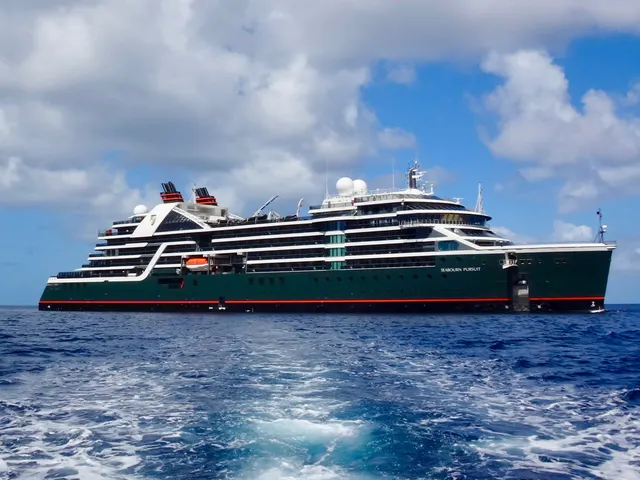
Year Built
2023
Tonnage
23,000 GT
Passengers
264
Crew
230
Decks
8
Class
Polar Class 6 Expedition
Itinerary & Route Map
Loading map…
Where this cruise calls, day by day
10 ports and 4 sea days over 13 Nights.
- Day 1
Lautoka
FijiDepartLautoka is Fiji's second city and the sugar port on the dry western side of Viti Levu - cane trains, a mill, and none of the resort gloss. Ships dock at Queens Wharf close to the town grid. Most passengers head straight out, because Nadi, the Sabeto valley and the boats to the Mamanuca islands are all within easy reach.
- Sri Siva Subramaniya temple in Nadi, the largest Hindu temple in the South Pacific
- Garden of the Sleeping Giant orchid collection under the Sabeto range
- Viseisei village, held to be Fiji's oldest settlement
- Lautoka Municipal Market for kava, produce and handicrafts
- Getting ashore
- Docked at the commercial wharf; town is about a 20-minute walk with a shuttle usually running, and Nadi or Denarau is 25-40 minutes by taxi.
- Best months
- May-Oct (dry season)
- Day 2
Kadavu
FijiPortWorth checking your itinerary here, because ships listed for Kadavu almost never stop at Vunisea, the administrative town on the main island. The call is nearly always Dravuni, a two-square-kilometre islet at the northern end of the group sitting on the Great Astrolabe Reef, with about two hundred residents and a beach on either side. Nothing on Dravuni is more than a twenty-minute walk.
- Snorkelling straight off the beach to the right of the tender landing
- The short ridge climb to Dravuni's high point for the reef panorama
- Local boat drops onto the Great Astrolabe Reef, one of the world's largest barrier reefs
- Walking through Dravuni village and its craft stalls
- Getting ashore
- Tender to a small pontoon or beach landing at Dravuni; there is no wharf, no vehicles and no infrastructure beyond the village.
- Best months
- May-Oct (dry season)
- Day 3
Fulaga
FijiPortFulaga is a raised limestone atoll in Fiji's remote southern Lau Group, a long way from anywhere and reached by only a handful of expedition ships and cruising yachts each year. Its lagoon is full of small mushroom-shaped islets, undercut at the waterline by erosion. The three villages are known across Fiji for woodcarving, particularly kava bowls, and visitors are expected to present sevusevu to the chief before anything else.
- Zodiac or small-boat trip among the undercut limestone islets in the lagoon
- Sevusevu welcome and kava ceremony in one of the villages
- Woodcarving demonstrations, the island's best-known craft
- Snorkelling in the lagoon's clear shallow water
- Getting ashore
- No wharf for ships - landing is by Zodiac or tender through the lagoon pass, and the call depends on both weather and village permission.
- Best months
- May-Oct (dry season)
Day 4 · At sea
- Day 5
Neiafu (Vava'u)
TongaPortNeiafu sits on the Port of Refuge, a deep, sheltered, almost landlocked harbour in Tonga's Vava'u group, which is why it has been a Pacific yachting hub for decades. The town is small and low-key. Between roughly July and October humpback whales come into these waters to calve, and Tonga is one of the very few places where regulated in-water swims with them are permitted.
- Humpback whale watching, and licensed in-water encounters in season
- Swallows Cave on Kapa Island, entered by boat
- Mariner's Cave, entered through an underwater tunnel to surface inside
- Mount Talau, a one-kilometre climb for the view over the Port of Refuge and its forty islets
- Getting ashore
- Ships anchor in the harbour and tender to the Neiafu waterfront; the town, the market and St Joseph's Cathedral are all a short walk from the landing.
- Best months
- Jul-Oct (humpback season and drier weather)
- Day 6
Nukupule Island (Ha'apai)
TongaPortNukupule is a small uninhabited islet in Tonga's Ha'apai group, roughly 19km west of Lifuka, the group's main island. It is an expedition-ship beach stop rather than a scheduled port - no village, no wharf, no facilities and nothing to walk to. Ha'apai's better-known sights are all on other islands and are not reachable from here in a day, so take the ship's own briefing over anything written in advance.
- Beach landing and swimming off an uninhabited cay
- Snorkelling on the surrounding reef straight from the shore
- A ship-staged beach barbecue, if your operator runs one
- Humpback whales in Ha'apai waters during the winter season
- Getting ashore
- Zodiac or tender beach landing only - there is no wharf and no settlement on the island.
- Best months
- Jun-Oct (dry season, overlapping the humpback season)
- Day 7
Apia
SamoaPortApia is a low-rise capital strung along a harbour on Upolu's north coast, with the mountains rising behind it. Ships berth at Matautu Wharf close to town. Samoa is intensely Christian and Sunday genuinely shuts down - if your call lands on one, expect closed shops, full churches and very good singing.
- Robert Louis Stevenson Museum at Vailima, with the climb to his tomb on Mount Vaea
- Palolo Deep Marine Reserve at Vaiala, snorkelling within walking distance of town
- Papase'ea Sliding Rocks, about 15 minutes out
- To Sua Ocean Trench on the south coast - spectacular, but a long half-day drive
- Getting ashore
- Docked at Matautu Wharf; the town centre is about 1.5km, a flat 20-minute walk west along Beach Road, or an unmetered taxi where you agree the fare first.
- Best months
- May-Oct (dry season)
Day 8 · At sea
Day 9 · At sea
- Day 10
Aitutaki
Cook IslandsPortAitutaki has one of the most photographed lagoons in the Pacific - a wide triangle of shallow water studded with sand motus. The catch is access. Ships anchor in open ocean outside the reef and tender a long way in to Arutanga, and swell cancels the call often enough that you should treat the visit as provisional until the anchor is down.
- Lagoon cruise to One Foot Island (Tapuaetai), where the tiny post office stamps passports
- Snorkelling over the giant clams, and the stop at Honeymoon Island
- Climbing Maunga Pu, all 124 metres of it, for the whole-lagoon view
- Standing on the Visitor's Rock by the tender pier, the local welcome custom
- Getting ashore
- Tender in to the Arutanga wharf - ships cannot enter the lagoon, so the anchorage is outside the reef, the ride is long, and surf cancels this call more often than almost any other in the Pacific.
- Best months
- May-Oct (dry season)
Day 11 · At sea
- Day 12
Raiatea
French PolynesiaPortRaiatea matters more than it looks. This was Hawaiki, the departure point for the voyaging canoes that settled Hawaii and New Zealand, and its great marae is a UNESCO site. Ships tie up at Uturoa's town wharf, which is rare in French Polynesia - no tender queue. The island shares a single lagoon with Taha'a next door.
- Taputapuatea marae, the most important pre-European religious site in the Pacific
- Boat trip up the Faaroa, the only navigable river in French Polynesia
- Uturoa market, busiest on Wednesday and Friday mornings
- Fifteen-minute ferry across the lagoon to Taha'a for vanilla and pearl farms
- Getting ashore
- Docked at the Gare Maritime in the centre of Uturoa - one of only two real cruise berths in French Polynesia; the town starts at the terminal door.
- Best months
- May-Oct (dry season)
- Day 13
Huahine
French PolynesiaPortHuahine is the quiet one in the Society Islands - two islands joined by a short bridge across Maroe Bay, more farming than tourism, and almost nothing built for cruise passengers. Where you land depends on the ship, and one of the options has essentially no village attached to it. What Huahine does have is the best-preserved pre-European archaeological landscape in the Societies.
- Maeva, a hillside of restored marae and the Fare Pote'e meeting house
- The sacred blue-eyed eels in the stream at Faie
- Avea Bay on Huahine Iti for swimming
- Ancient stone fish traps in Lake Fauna Nui, still in use
- Getting ashore
- Tender only, and the landing varies by ship - some tender to Fare, which has shops and a beach, others to Maroe Bay, which has almost nothing and relies on open-air trucks to carry you across to Fare.
- Best months
- May-Oct (dry season)
- Day 14
Papeete
French PolynesiaArrivePapeete is the administrative and shipping capital of French Polynesia rather than the postcard version of it, and most Tahiti itineraries begin or end here. The quay is right in town, so you step off into traffic, gendarmes and a French-Polynesian city that works for a living. The scenery people came for is mostly on the other islands, or up in Tahiti's interior valleys.
- Marche de Papeete, the two-storey municipal market for vanilla, monoi and pareu
- Les roulottes, the food-truck park at Place Vaiete that fills up after dark
- Point Venus and Matavai Bay, where Cook observed the transit of Venus
- Musee de Tahiti et des Iles at Punaauia for Polynesian navigation and tattoo history
- Getting ashore
- Docked at the Quai d'Honneur in the middle of town; the market is about a block away and no shuttle is needed.
- Best months
- May-Oct (dry season)
Onboard Amenities
Cruise Highlights
About the Ship
What Travelers Say About Seabourn Pursuit
Reviews of the ship itself — the same for every Seabourn Pursuit sailing. Based on 250 discussions.
Seabourn Pursuit, launched in 2023 as the sister to Seabourn Venture, is Seabourn's purpose-built ultra-luxury expedition ship, and it stands out by pairing genuine polar-capable adventure with the pampering of a high-end small-ship cruise. Carrying up to 264 guests in all-suite, veranda accommodations, it sails bucket-list expedition routes - Antarctica, the Australian Kimberley, Chilean fjords and the South Pacific - while keeping the caviar-on-demand, all-inclusive, white-glove Seabourn vibe. Reviewers consistently describe a polished, comfortable atmosphere where a deep expedition team and a near one-to-one crew ratio do the heavy lifting.
What People Love
- Genuinely ultra-luxury take on expedition cruising - all-suite accommodations with verandas, marble baths and high-end finishes far above typical expedition ships
- Near one-to-one crew-to-guest ratio (around 238 crew for 264 max guests) delivers intuitive, personalized service that reviewers repeatedly call a highlight
- Outstanding 24-to-26-member expedition team of geologists, marine biologists and ornithologists leading Zodiac landings and well-regarded onboard lectures
Common Complaints
- The signature submarines were withdrawn fleet-wide in early 2026, so the underwater-exploration feature heavily marketed at launch is no longer available
- At up to 264 guests it is large for an expedition ship versus rivals like Ponant and Lindblad (roughly 126-184), meaning bigger groups and fewer intimate wildlife encounters
- Multiple reviewers feel the cuisine, while high-end, is safe and underwhelming and that the Colonnade lags rivals like Regent, Silversea, Viking and Oceania
More South Pacific Cruises
View all South Pacific cruisesWindstar Cruises
Star Breeze - Tahiti & French Polynesia
Windstar Cruises
Star Breeze - Flowers of the South Pacific: Tahiti to Fiji
Celebrity Cruises
Celebrity Edge - Tahitian Treasures: Honolulu to Sydney
Windstar Cruises
Star Breeze - Magnificent Marquesas & Tuamotus