Diamond Princess - Circle Japan Spring Flowers
Diamond Princess - the Japan-built veteran of Princess' year-round Japan program - loops the entire archipelago from Yokohama at cherry-blossom peak, calling at nine ports on both the Pacific and Sea of Japan coasts.
Price Range
$
Budget
*Prices vary by cabin type, sailing date, and availability. Confirm rates with Princess Cruises before booking.
Ship Details — Diamond Princess
View full Diamond Princess details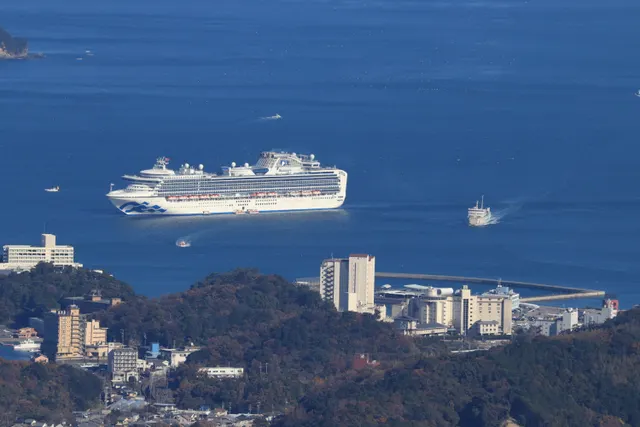
Year Built
2004
Tonnage
115,875 GT
Passengers
2,670
Crew
1,100
Decks
18
Class
Grand
Itinerary & Route Map
Loading map…
Where this cruise calls, day by day
11 ports and 1 sea day over 11 Nights.
- Day 1
Tokyo
JapanDepartMost itineraries that say Tokyo actually berth at Yokohama, half an hour down the bay - Osanbashi Pier for medium ships, Daikoku Pier for the very large ones, with the Tokyo International Cruise Terminal at Odaiba as the third option. Yokohama is not a consolation prize: Osanbashi opens straight onto the waterfront, with Chinatown and Minato Mirai on foot. But if you want Tokyo proper, budget the round trip and pick two neighbourhoods rather than five.
- Senso-ji temple and Nakamise shopping street in Asakusa
- Meiji Jingu shrine and the walk down through Harajuku to Shibuya Crossing
- The Imperial Palace East Gardens and the Tokyo National Museum in Ueno
- Yokohama's Chinatown, Sankeien Garden and the Minato Mirai waterfront
- Getting ashore
- Docked. Osanbashi Pier in Yokohama is walkable to Chinatown and about 30 minutes by train from central Tokyo; Daikoku Pier is an industrial berth 15km out needing a shuttle, and Odaiba's terminal is on the Yurikamome line.
- Best months
- Late Mar-early Apr (cherry blossom), Oct-Nov (autumn colour)
Day 2 · At sea
- Day 3
Busan
South KoreaPortBusan is Korea's port city and second-largest, wedged between mountains and beaches with a working fish market at its heart. Ships use the international terminal near Busan Station, which puts the old downtown within a short taxi ride. The two things people remember are Jagalchi's tanks of live seafood and the painted hillside houses of Gamcheon.
- Jagalchi Fish Market and the neighbouring Gukje Market
- Gamcheon Culture Village, the terraced hillside of painted houses
- Haedong Yonggungsa, a Buddhist temple built right on the rocks above the sea
- Beomeosa Temple on the slopes of Geumjeongsan, or the sand at Haeundae
- Getting ashore
- Docked, but check which terminal - the Busan Port International Passenger Terminal in North Port is beside Busan Station, while the largest ships use the Yeongdo cruise terminal out on the island, which has no walk-out option and depends on shuttles.
- Best months
- Apr-Jun and Sep-Oct (mild, dry); Jul-Aug brings the monsoon
- Day 4
Nagasaki
JapanPortNagasaki is built up the sides of a narrow harbour, and the cruise terminal at Matsugae sits at the bottom of the hillside that holds most of what you came to see. This was Japan's only window on the outside world for two centuries, so there is a Dutch trading post, a Chinatown and a hillside of Western merchant houses - and then, at the north end of the city, the ground zero of the second atomic bomb.
- Glover Garden and Oura Church, both a short walk uphill from the terminal
- Dejima, the reconstructed Dutch trading island
- The Peace Park and the Atomic Bomb Museum in Urakami
- A boat out to Hashima (Gunkanjima), the abandoned coal-mining island
- Getting ashore
- Docked at Matsugae International Terminal; Glover Garden and Oura Church are a 10-15 minute walk, and the tram from nearby reaches the Peace Park in roughly 20 minutes.
- Best months
- Mar-May and Oct-Nov; Jun is the rainy season
- Day 5
Sakaiminato
JapanPortSakaiminato is a fishing port on a sandspit in Tottori, best known at home as the birthplace of the manga artist Mizuki Shigeru - the main street out of the station is lined with bronze statues of the yokai spirits he drew. Beyond that novelty, it is the landing point for the Matsue and Izumo area, which holds one of Shinto's oldest and most important shrines.
- Mizuki Shigeru Road and its bronze yokai figures, a short walk from the pier
- Matsue Castle, one of the few surviving original keeps
- The Adachi Museum of Art, as famous for its garden as its paintings
- Izumo Taisha, the ancient grand shrine, further west
- Getting ashore
- Docked at Sakaiminato; Mizuki Shigeru Road is 10-15 minutes on foot, Matsue about 40 minutes by road, and Izumo Taisha roughly 90 minutes.
- Best months
- Apr-May and Oct-Nov
- Day 6
Maizuru
JapanPortMaizuru is in Kyoto Prefecture but on the wrong coast for the Kyoto everyone pictures - it faces the Sea of Japan, and the city is a former Imperial Navy base with a row of red-brick warehouses to show for it. It works as a landing point for the Tango peninsula rather than as a destination. Kyoto city is reachable but takes most of the day.
- The Maizuru Red Brick Park, former naval storehouses now museums and cafes
- Amanohashidate, the pine-covered sandbar counted among Japan's three great views
- The funaya boathouses of Ine, built out over the water
- Kyoto's temples, if you are willing to spend four hours on the road
- Getting ashore
- Docked at Maizuru Port; the Red Brick Park is a few minutes away, Amanohashidate roughly an hour west, and Kyoto city about two hours south.
- Best months
- Apr-May and Oct-Nov
- Day 7
Kanazawa
JapanPortKanazawa came through the war unbombed, so its geisha districts and samurai quarter are the real thing rather than reconstructions. The city sits on the Sea of Japan coast and made its money from rice and gold leaf, which is why the gardens are so good and why half the souvenirs are gilded. The port is a few kilometres out at Mukaihama, so you will be shuttled in.
- Kenrokuen, generally ranked among Japan's three great landscape gardens
- The Higashi Chaya teahouse district and its gold-leaf workshops
- Kanazawa Castle Park, next door to Kenrokuen
- Omicho Market for crab and sea urchin, and the 21st Century Museum of Contemporary Art
- Getting ashore
- Docked at Kanazawa Port (Mukaihama Pier), roughly 10km from the centre - 20-30 minutes by shuttle or taxi to Kenrokuen and the old districts.
- Best months
- Apr-May and Oct-Nov; heavy snow Dec-Feb
- Day 8
Sakata
JapanPortSakata grew rich shipping rice down the Mogami river and out along the Sea of Japan coast, and the physical evidence is still standing: a row of black-walled warehouses backed by a screen of zelkova trees planted to keep the grain cool. The town is small and easily covered. Inland are the Dewa Sanzan, three sacred mountains that pilgrims have been walking for well over a thousand years.
- The Sankyo Rice Warehouses and their avenue of zelkova trees
- Somaro, a former merchants' teahouse with daily maiko dances
- The five-storey pagoda and cedar-lined stone stairway on Mount Haguro
- The Homma Museum of Art and its garden
- Getting ashore
- Docked at Sakata Port; the rice warehouses and old merchant quarter are about 10 minutes away, and Mount Haguro roughly an hour inland.
- Best months
- May-Jun and Sep-Oct
- Day 9
Hakodate
JapanPortHakodate was one of the first Japanese ports opened to foreign trade, and it still shows in the Russian church, the Western-style buildings and the hillside of consulates in Motomachi. The town sits on a narrow isthmus with a mountain at one end, and the night view from the top is the thing it is famous for - though cruise schedules rarely allow it. The morning market by the station is the more realistic pleasure.
- Hakodate Morning Market, for uni, crab and squid you catch yourself
- The Motomachi slopes, the Russian Orthodox Church and the old public hall
- The Kanemori Red Brick Warehouses on the waterfront
- Goryokaku, the star-shaped Western-style fort, and its tower
- Getting ashore
- Docked in Hakodate Port near the centre; the morning market and the red-brick warehouses are within about 15 minutes, and the Mount Hakodate ropeway a short ride further.
- Best months
- May-Jun and Sep-Oct; the cherry blossom at Goryokaku peaks late Apr-early May
- Day 10
Miyako
JapanPortMiyako is a small fishing city on the Sanriku coast of Iwate, in northern Honshu, and it was one of the places worst hit by the 2011 tsunami. Cruise calls here are infrequent, and the draw is the coastline rather than the town: white rhyolite cliffs and pines dropping into very clear water, protected as part of a national park.
- Jodogahama Beach and its white rock spires
- Boat trips along the Sanriku cliffs from Jodogahama
- Local seafood - this is a scallop, sea urchin and salmon coast
- Tsunami memorial sites and reconstruction along the shore
- Best months
- Jun-Sep (mild, clearest sea conditions)
- Day 11
Hitachinaka
JapanPortHitachinaka is a working port on the Ibaraki coast north-east of Tokyo, and it is on cruise itineraries essentially because of one attraction a few minutes away. Hitachi Seaside Park is a former airfield planted with millions of flowers, and twice a year it turns a colour that is hard to describe without sounding as though you are exaggerating - blue with nemophila in spring, deep red with kochia bushes in autumn. Outside those windows the call is much quieter.
- Hitachi Seaside Park - the nemophila hills in spring, the kochia in October
- Oarai Isosaki Shrine and its torii standing on the rocks in the surf
- Kairakuen garden in Mito, famous for its plum blossom in late winter
- Nakaminato fish market, close to the port
- Getting ashore
- Docked at the Hitachinaka district of Ibaraki Port; Hitachi Seaside Park is only 10-15 minutes away, while Tokyo is roughly two hours by road.
- Best months
- Late Apr-May (nemophila), mid-Oct (kochia)
- Day 12
Tokyo
JapanArriveMost itineraries that say Tokyo actually berth at Yokohama, half an hour down the bay - Osanbashi Pier for medium ships, Daikoku Pier for the very large ones, with the Tokyo International Cruise Terminal at Odaiba as the third option. Yokohama is not a consolation prize: Osanbashi opens straight onto the waterfront, with Chinatown and Minato Mirai on foot. But if you want Tokyo proper, budget the round trip and pick two neighbourhoods rather than five.
- Senso-ji temple and Nakamise shopping street in Asakusa
- Meiji Jingu shrine and the walk down through Harajuku to Shibuya Crossing
- The Imperial Palace East Gardens and the Tokyo National Museum in Ueno
- Yokohama's Chinatown, Sankeien Garden and the Minato Mirai waterfront
- Getting ashore
- Docked. Osanbashi Pier in Yokohama is walkable to Chinatown and about 30 minutes by train from central Tokyo; Daikoku Pier is an industrial berth 15km out needing a shuttle, and Odaiba's terminal is on the Yurikamome line.
- Best months
- Late Mar-early Apr (cherry blossom), Oct-Nov (autumn colour)
Onboard Amenities
Cruise Highlights
About the Ship
What Travelers Say About Diamond Princess
Reviews of the ship itself — the same for every Diamond Princess sailing. Based on 4,500 discussions.
Diamond Princess is a 2004-built, roughly 2,670-guest Princess ship that has carved out a unique niche as the line's Japan-based vessel, sailing intensive itineraries around the country with a distinctly Japanese onboard flavor. Its single most distinctive feature is the Izumi Japanese Bath, an 8,800-square-foot onsen complex with indoor and outdoor bathing that no other cruise ship offers. The ship is widely remembered as the 2020 COVID quarantine vessel, but its current reputation rests on warm service and immersive Japanese cruising rather than that episode.
What People Love
- Excellent, attentive crew service repeatedly singled out as the highlight of the experience
- The only ship at sea with a full onsen - the 8,800-sq-ft Izumi Japanese Bath with indoor and outdoor pools
- Outstanding Japanese cuisine, including sushi, fresh seafood and a popular ramen station in the buffet
Common Complaints
- Built in 2004, the ship feels dated in decor, cabins and some amenities despite refits
- Bathrooms are a common gripe - very compact showers with plastic curtains and temperamental taps
- Air conditioning and cabin systems reflect the ship's age and are not always efficient
More Asia Cruises
View all Asia cruisesSilversea
Silversea Silver Moon - Grand Voyage Asia
Silversea
Silver Moon - Hong Kong to Tokyo: Taiwan, Korea & Japan
Seabourn
Seabourn Ovation - Gems of Southeast Asia: Singapore to Hong Kong
Silversea
Silver Dawn - Singapore to Mumbai: Sri Lanka & the Spice Coast